Reprinted by permission from The News of Orange
By KERI SPRENGER
Staff Writer
Jeffrey Ruffin is a man who likes to give. He gives of his time to those in need, whether they need help changing a tire, jumpstarting a car or handing out meals to the hungry through Neighbor House’s Food For All program. He holds elevator doors for folks, and helps solicit people to fill out surveys for Men for Health, a program aimed at informing men about prostate cancer.
“That’s sometimes how my day will go. I know if I can help somebody, somewhere down the line, it will come back to me,” he said.
What he can’t give of is his money, because he hasn’t much. But he’s never begged for anything from anyone, he says proudly.
When asked point blank what his housing status is, Ruffin sighs and looks away.
“I guess I am homeless.”
The 47-year old grandfather spends the coldest nights at his sister’s house in Hillsborough. But because she receives housing assistance, he can’t stay there often except to shower and catch a few hours of rest.
During the day, he tries to put on enough clothes to stay warm outside.
“My daily activity is just trying to make it through the day,” he said.
He sometimes sleeps at the Inter-Faith Council’s shelter for men in Chapel Hill. The police in Chapel Hill know Ruffin, and he said they always offer to give him a ride to IFC if he needs it. But his arrival at the shelter is largely dependent upon catching the Orange Public Transportation bus heading south from Hillsborough. The bus stops running at 6 p.m, and Ruffin only rides it if he has the $1.50 one-way fare.
If not, he might end up sleeping in the woods that night, kept company by his friends who also have no place to call home.
Injury one cause of homelessness
Ruffin’s homelessness is due in part to a fall that shattered his ankle in 2003. He also suffers from degenerative disc disease, a condition in which the discs that separate the vertebrae of the spine lose moisture to the point where the bones fuse together. If not for those factors, he could still drive trucks, which is how he made his living prior to the injury. He also has experience in glasswork, building boats and furniture, and is somewhat computer- inclined.
He has applied for disability, and has been turned down twice for benefits. He will have a third hearing in March. “That’s my hardship right now — waiting on my disability,” he said.
On cold days, he has difficulty getting from one place to another yet relies on his own two feet to get him where he needs to go. Occasionally, someone might stop and give him a ride.
“A lot of people see me, they think I’m able to work,” he said.
But that isn’t the case. Ruffin can’t hold a steady job because of his injury.
He receives food stamps, so he doesn’t worry about what he will eat from day to day. Medicaid pays for his medication, of which he takes seven different types. One has a copay of $170, and lasts him a month at best. It’s tough finding that money, he said, but sometimes, the county’s Social Services department is able to help him out.
When the past comes back to haunt you
There is also the problem of his past.
Ruffin admits he may not have made the best choices in years gone by. He had a drug abuse problem, which resulted in several felonies that show up on a criminal background check.
“Sometimes, your lifestyle in the past will come back to haunt you,” he said.
Due to his past mistakes, Ruffin is unable to keep a stable lifestyle or a job. Some employers won’t even give him a chance because of his background.
He said that’s wrong.
“If I paid my due to society, I should have the opportunity to move on,” he said. “Everyone sees you, the first instinct is, ‘you’re less than.’
“I think sometimes society throws you away [even] when there’s something you could do.”
Ruffin has applied to Vocational Rehabilitation to try to find a job while he’s been waiting for his disability to come through. They were unable to help him because he has applied for the disability, which assumes that he is unable to work.
“You still have to go out like a regular person and look for a job,” he said.
Existing day to day on faith
On a good day, Ruffin will be moving around without much pain and might even get to visit with the guys at Papa Pizzeria on N.C. 86 in Chapel Hill and stay warm inside the restaurant.
They reach out to people, he says of the restaurant’s staff.
“A lot of times, conversation will get a person through,” he said.
Ruffin’s faith in God has helped him during his past four years of homelessness.
“I’m blessed, even in my position. I’m gonna get a breakthrough,” he said, eyes shining.
He said people in Hillsborough pass him on the street as he is struggling to get from place to place due to his ankle problems. Sometimes he sees the same people pass him by without stopping.
“First picture they see, they write the story,” he said. “I just wish they’d ask.
“I’m a firm believer that before you look down on a person, reach down to help them up. In the Bible, God says how you going to love Him when you don’t love the people here on earth?”
If his disability benefits are approved next month, Ruffin can expect roughly $800 a month to live on, he said. With the average housing price in Orange County’s 2005 Out of Reach report listed at $673, Ruffin knows more challenges lie ahead for him.
“You’re going without something [at that amount],” he said.
Ruffin said he is encouraged by the work being done by different organizations around the county, and hopes to see the day when no one is without basic necessities.
“[The homeless] really need some help to move from one point to the next level,” he said.
He doesn’t expect a handout from anybody. He said he would just like to have a job and a home like other people.
“Shelter — somewhere I can come home and stick a key in the door,” he said. “That’s the main thing — having a place to call your own.”
He missed seeing his children grow up. He doesn’t want the same thing to happen with his grandchildren. When he has his own place, his grandchildren and other relatives can come visit him, he said.
He pulls out a small toy, which he said he bought for his niece. He smiles as he turns it over in his hand.
“I keep a positive attitude. I know even with me being without, I’m going to be alright,” he said. “Sometimes, you just have to bear the cross and move on.”
Friday, March 16, 2007

Homelessness article from The News of Orange, part 1
Reprinted by permission from the News of Orange
By KERI SPRENGER and CASEY FERRELL
Marilyn Ghezzi stepped out of the back seat of the patrol car with her clipboard and approached the man with the scraggily, dirty beard. She introduced herself and then got right to the point.
“Do you have a place to sleep tonight?” she asked.
The man, with somewhat slurred but coherent speech, answered that yes, he has a place to sleep. He has some kin that live right around the corner, and he sleeps there. But not always.
The man tells Ghezzi that he doesn’t have a home, that he sometimes doesn’t have a place to sleep. From the tattered appearance of his clothes, it’s not hard to imagine the man’s been through some rough nights outdoors.
After a few more questions, the man accepts the gifts of socks and crackers Ghezzi offers him and heads down the road to where food is being served at Fairview Baptist Church.
The man is one of Hillsborough’s homeless. And he’s not the only one.
Ghezzi is part of a volunteer force that canvassed the county on Jan. 24 trying to count them all.
THE POINT IN TIME COUNT
Vanessa Neustrom observes daily the devastating effects that homelessness can have. She’s the housing coordinator for Orange Person Chatham (OPC), an area non-profit.
It’s not an easy job, and this year it was made even tougher when she was tapped to lead the Point In Time count, an annual tally of the county’s homeless.
Each year, a verification is needed in the county of all those who are considered homeless according to guidelines set forth by the Department of Housing and Urban Development, or HUD. HUD defines the homeless as those living “in places not meant for human habitation, such as cars, parks, sidewalks, abandoned buildings or tents” and those in emergency or transitional shelters.
Thus there are two categories of homeless — the emergency homeless, who live on the streets, and the sheltered homeless, who stay in homeless shelters.
For the Point In Time count, the county is divided into three different sections. Those sections are Chapel Hill/Carrboro, Hillsborough and unincorporated areas of the county. Some volunteers look for the emergency homeless, while others head to the shelters to interview the people staying there.
The count is conducted in January, Neustrom said, because the cold weather helps push the homeless into shelters where they’re more easily counted. If it was done when the weather was nicer, many of the homeless would be spread all over the county, living outdoors where they are harder to find and count.
Neustrom said police officers usually identify sites in the county where people have been spotted hanging out, including underpasses and any abandoned trailers. In past years, information from hospital officials and hotel clerks has aided the volunteers in their efforts of identifying those in need.
Once sites are identified, volunteers accompany police to interview people. The count’s integrity rests on following a prescribed format and asking as many questions as possible. Some of the people interviewed said they wouldn’t have considered themselves homeless but, according to materials provided by HUD, they fit the definition of homeless. Questions asked in regards to physical health, mental health, substance abuse issues and employment status help in this determination.
There is a reason for asking for more information than just whether or not the person is homeless.
“We’re trying to gauge where that person sits in the range of homelessness,” Neustrom said.
The overall numbers, which won’t be released until Feb. 13, will give what the agency hopes is an accurate representation of the sheltered and unsheltered homeless populations,
The information gathered will then be sent to the North Carolina Inter-Agency Council. OPC staff members will also report the information on their continuum of care application to the federal government. Money received from those grants is converted to housing funds OPC can use to help families in the area.
They currently serve 22 customers with the funds they have. But there are others still in need, those that are in danger of becoming homeless as well.
“We get phone calls once a week at least of [people looking for help],” Neustrom said.
STRIVING FOR ACCURACY
Despite their best efforts, Neustrom knows there are more people out there without a home. The numbers the agency will derive from this count do not incorporate those who are “doubled-up,” or living with friends and relatives whenever there’s room.
“Not every homeless person will be counted, and all the information we strive to gather during the count cannot be gathered in its entirety,” Neustrom said. “Unsheltered individuals are more difficult to locate and/or identify, or perhaps they were not accessing services on the day of the count. Also, information cannot be gathered in its entirety because once a person is identified as homeless on the day of the count, he or she still does not have to provide any information about themselves or the factors related to their homelessness if they don’t wish to.
“Some information is better than none, but the data is inherently incomplete.”
On the night of the count, a pair of volunteers canvassing Hillsborough interviewed about five people, most of whom would be considered the emergency homeless.
Hillsborough Police Department Capt. Judy Jacobs said she thought that five was an accurate number.
Jacobs, who along with Sgt. Irving Davis accompanied the volunteers on the count, said this is the third year she has helped identify sites where the homeless might be sleeping.
“Last year, the count was higher than this year,” Jacobs said.
She acknowledged that there could be more people inside of homes, staying with friends. The temperature was about 10 degrees colder than last year.
Jacobs said she was a little apprehensive about volunteers just walking up and asking people straight out if they were homeless or not. But she also saw the value in it.
“It appeared that they wanted help,” she said.
In the three years that she has been coordinating efforts with volunteers for this count, Jacobs said she has changed her tune about who is really homeless.
“My definition is someone who has nowhere to go,” she said.
Now that she has been “schooled,” as she calls it, she looks at the problem of homelessness in a new light.
“It’s been an eye opener each year,” she said.
Jim Martin, a volunteer who works with the Caring Family Network, said his task was to count the emergency homeless, which he felt they were able to do on a night when many would seek shelter with friends or at the homeless shelters in Chapel Hill or Durham.
“It seemed like we were checking reasonable places,” he said.
After the interviews, Martin and his volunteer partner Ghezzi, handed out the care packages that included socks and crackers.
Neighbor House’s Food For All program, begun in November 2005, has been serving between 300 and 350 meals a week at Fairview Baptist Church and at Southern Comfort Inn in Daniel Boone Village. Other Point In Time volunteers were conducting counts at the food distribution sites, so the number of Hillsborough’s homeless will be determined by the combined totals of all the teams of volunteers who counted that night.
COMING TOGETHER
Martin said that he felt like volunteering was a good way to help his fellow service providers.
“In order to keep getting the funding, we need the data,” he said.
Neustrom said that when she put out the call that volunteers would be needed for the count, agencies around the county stepped up to the plate.
“I was encouraged throughout the process because every agency we contacted came through with enthusiasm,” she said. “It made me proud of Orange County.”
By KERI SPRENGER and CASEY FERRELL
Marilyn Ghezzi stepped out of the back seat of the patrol car with her clipboard and approached the man with the scraggily, dirty beard. She introduced herself and then got right to the point.
“Do you have a place to sleep tonight?” she asked.
The man, with somewhat slurred but coherent speech, answered that yes, he has a place to sleep. He has some kin that live right around the corner, and he sleeps there. But not always.
The man tells Ghezzi that he doesn’t have a home, that he sometimes doesn’t have a place to sleep. From the tattered appearance of his clothes, it’s not hard to imagine the man’s been through some rough nights outdoors.
After a few more questions, the man accepts the gifts of socks and crackers Ghezzi offers him and heads down the road to where food is being served at Fairview Baptist Church.
The man is one of Hillsborough’s homeless. And he’s not the only one.
Ghezzi is part of a volunteer force that canvassed the county on Jan. 24 trying to count them all.
THE POINT IN TIME COUNT
Vanessa Neustrom observes daily the devastating effects that homelessness can have. She’s the housing coordinator for Orange Person Chatham (OPC), an area non-profit.
It’s not an easy job, and this year it was made even tougher when she was tapped to lead the Point In Time count, an annual tally of the county’s homeless.
Each year, a verification is needed in the county of all those who are considered homeless according to guidelines set forth by the Department of Housing and Urban Development, or HUD. HUD defines the homeless as those living “in places not meant for human habitation, such as cars, parks, sidewalks, abandoned buildings or tents” and those in emergency or transitional shelters.
Thus there are two categories of homeless — the emergency homeless, who live on the streets, and the sheltered homeless, who stay in homeless shelters.
For the Point In Time count, the county is divided into three different sections. Those sections are Chapel Hill/Carrboro, Hillsborough and unincorporated areas of the county. Some volunteers look for the emergency homeless, while others head to the shelters to interview the people staying there.
The count is conducted in January, Neustrom said, because the cold weather helps push the homeless into shelters where they’re more easily counted. If it was done when the weather was nicer, many of the homeless would be spread all over the county, living outdoors where they are harder to find and count.
Neustrom said police officers usually identify sites in the county where people have been spotted hanging out, including underpasses and any abandoned trailers. In past years, information from hospital officials and hotel clerks has aided the volunteers in their efforts of identifying those in need.
Once sites are identified, volunteers accompany police to interview people. The count’s integrity rests on following a prescribed format and asking as many questions as possible. Some of the people interviewed said they wouldn’t have considered themselves homeless but, according to materials provided by HUD, they fit the definition of homeless. Questions asked in regards to physical health, mental health, substance abuse issues and employment status help in this determination.
There is a reason for asking for more information than just whether or not the person is homeless.
“We’re trying to gauge where that person sits in the range of homelessness,” Neustrom said.
The overall numbers, which won’t be released until Feb. 13, will give what the agency hopes is an accurate representation of the sheltered and unsheltered homeless populations,
The information gathered will then be sent to the North Carolina Inter-Agency Council. OPC staff members will also report the information on their continuum of care application to the federal government. Money received from those grants is converted to housing funds OPC can use to help families in the area.
They currently serve 22 customers with the funds they have. But there are others still in need, those that are in danger of becoming homeless as well.
“We get phone calls once a week at least of [people looking for help],” Neustrom said.
STRIVING FOR ACCURACY
Despite their best efforts, Neustrom knows there are more people out there without a home. The numbers the agency will derive from this count do not incorporate those who are “doubled-up,” or living with friends and relatives whenever there’s room.
“Not every homeless person will be counted, and all the information we strive to gather during the count cannot be gathered in its entirety,” Neustrom said. “Unsheltered individuals are more difficult to locate and/or identify, or perhaps they were not accessing services on the day of the count. Also, information cannot be gathered in its entirety because once a person is identified as homeless on the day of the count, he or she still does not have to provide any information about themselves or the factors related to their homelessness if they don’t wish to.
“Some information is better than none, but the data is inherently incomplete.”
On the night of the count, a pair of volunteers canvassing Hillsborough interviewed about five people, most of whom would be considered the emergency homeless.
Hillsborough Police Department Capt. Judy Jacobs said she thought that five was an accurate number.
Jacobs, who along with Sgt. Irving Davis accompanied the volunteers on the count, said this is the third year she has helped identify sites where the homeless might be sleeping.
“Last year, the count was higher than this year,” Jacobs said.
She acknowledged that there could be more people inside of homes, staying with friends. The temperature was about 10 degrees colder than last year.
Jacobs said she was a little apprehensive about volunteers just walking up and asking people straight out if they were homeless or not. But she also saw the value in it.
“It appeared that they wanted help,” she said.
In the three years that she has been coordinating efforts with volunteers for this count, Jacobs said she has changed her tune about who is really homeless.
“My definition is someone who has nowhere to go,” she said.
Now that she has been “schooled,” as she calls it, she looks at the problem of homelessness in a new light.
“It’s been an eye opener each year,” she said.
Jim Martin, a volunteer who works with the Caring Family Network, said his task was to count the emergency homeless, which he felt they were able to do on a night when many would seek shelter with friends or at the homeless shelters in Chapel Hill or Durham.
“It seemed like we were checking reasonable places,” he said.
After the interviews, Martin and his volunteer partner Ghezzi, handed out the care packages that included socks and crackers.
Neighbor House’s Food For All program, begun in November 2005, has been serving between 300 and 350 meals a week at Fairview Baptist Church and at Southern Comfort Inn in Daniel Boone Village. Other Point In Time volunteers were conducting counts at the food distribution sites, so the number of Hillsborough’s homeless will be determined by the combined totals of all the teams of volunteers who counted that night.
COMING TOGETHER
Martin said that he felt like volunteering was a good way to help his fellow service providers.
“In order to keep getting the funding, we need the data,” he said.
Neustrom said that when she put out the call that volunteers would be needed for the count, agencies around the county stepped up to the plate.
“I was encouraged throughout the process because every agency we contacted came through with enthusiasm,” she said. “It made me proud of Orange County.”
Wednesday, March 14, 2007
Way to Go Isaac!
By virtue of their victory, the McDougle eighth-graders advance to the state championship, to be held at the N.C. Museum of History in Raleigh on May 16.
Given the narrow focus on standardized tests in the three Rs, subjects like history are all too often relegated to the back burner. Yet few subjects are as rich or offer as many important lessons. It's good to see local students, and their coaches, recognize that.
McDougle, which represented the Chapel Hill-Carrboro school district, defeated Southeast Forsyth in the final game to win the regional title.
Captain of the McDougle team is Kyle Villemain and team members are Nick DiCecco, Jaime Morin and Isaac Warshauer. Coaches are Cissy O'Neal and Louise Peters. The principal is Debra H. Scott.
Good job, Mustangs. We're proud, but we can't say we're surprised; McDougle has won regional and state titles in past years. The school has a, um, history of doing well.Planning Around Public Health
"Peace, to have meaning for many who have only known suffering in both peace and war, must be translated into bread or rice, shelter, health and education, as well as freedom and human dignity.--Ralph Bunche
When our planning processes begin to address the full realm of human needs, instead of just property uses, then we truly become a country that seeks peace and equity for all people.
http://www.contracostatimes.com/mld/cctimes/16330982.htm
The California Endowment, a private health foundation that provides grants to community health organizations throughout the state, has given Richmond $255,000 to help facilitate the health-based planning concept.
General plan elements that will be developed within the context of public health include nutrition, bicycle and pedestrian safety, hazardous materials ordinances, air and water quality, homelessness and violent crime.
Since the early 20th century, cities have planned for aesthetic amenities such as parks, tree-lined streets and walkable neighborhoods. However, never before have city planners actually identified associated health benefits, Iacofano said.
Saturday, March 10, 2007
2007 Point In Time Count
Orange County Homelessness Fact Sheet
February 2007
February 2007
Total Number of Homeless People Counted in January 2007: 224
- Homeless people staying in temporary shelter: 199
- Homeless people without shelter (i.e. on the streets): 25
- Homeless families: 23
- Homeless people in families (including children): 60
- Homeless children: 35
- Homeless individuals (not in families): 164
- Homeless people with a history of domestic violence: 23
- Chronically homeless people: 71
In Orange County:
- A minimum wage earner (earning $5.15 per hour) must work 117 hours per week, 52 weeks per year, to afford the fair market rent (FMR) for a two-bedroom unit, which is $785 per month. An SSI recipient (receiving $603 monthly) can afford monthly rent of no more than $181, while the fair market rent for a one-bedroom is $603 (Out of Reach Report, 2006).
- In order to afford FMR for a two-bedroom unit ($785), without paying more than 30% of income on housing, a household must earn $2,617 monthly or $31,400 annually. Assuming a 40-hour work week, 52 weeks per year, this level of income translates into a Housing Wage of $15.10 (Out of Reach Report, 2006).
- In 2006, the Inter-Faith Council served 85,055 hot meals; provided 7,726 bags of groceries to 7,187 members of the community; granted 3,500 requests for food, cash, and help with utilities and other service needs representing more than 2,100 households; and offered 813 homeless individuals a place to sleep through its Community House and HomeStart program.
- Neighbor House, Inc. distributed at least 17, 680 dinners to members of Northern Orange County through its Food for All Program in 2006. They are currently serving an average of 85 meals per night, four nights per week.
- In 2005, the Community Initiative to End Homelessness received approximately $275,000 to provide permanent housing to homeless and disabled individuals or families. The funding is shared among OPC Area Program, the Chrysalis Foundation for Mental Health, Inter-Faith Council for Social Service and UNC Horizon’s. The CIEH applied for additional homeless assistance funding in 2006, but award letters have not been received as of 2/13/07.
Wednesday, March 07, 2007
Thank You Eddy Landreth
I do not want Tyler Hansborough to leave UNC, but I agree with Mr. Landreth that the physical abuse he has taken over the past couple of years became intolerable in Sunday's game against Duke. I listened with total disbelief as the CBS commentators assured us all that Gerald Henderson's elbow in Tyler's face was really an accident occuring during a legitimate attempt to capture a lose ball.
The ACC should be ashamed of itself for not protecting its most prized assets: its players.Either clean it up or petition the NBA to let these guys go pro right out of high school again. At least they could bank several million for whatever punishment they may endure.
The whole affair is disgusting and shameful, and that would be the case no matter which teams were playing and no matter which kid took the beating. It's just plain wrong.
Tuesday, February 20, 2007
Orange County Elementary Schools
Orange County School District has been put into Title I Improvement due to lack of progress in reading scores over the past three years. Using NC Report Card I pulled out the Snapshot data statistics on race and economic status for each of the elementary schools in the district. The racial and economic status columns in this table represent the percentage of students passing both reading and math tests. 46% of economically deprived students passed both compared to 70% of not economically deprived students. Clearly economic status is a factor in student performance in Orange County.
| School | White | Black | Hispanic | Econ Deprived | Not Econ Deprived |
| Cameron Park | 88 | 49.1 | 63.6 | 58.7 | 85.1 |
| Central | 57.7 | 32.1 | 60 | 47.4 | 46.5 |
| Cheeks | 58.4 | 26.6 | 33.3 | 36 | 53.3 |
| Grady Brown | 76.4 | 41.9 | 37.5 | 41.8 | 74.6 |
| Hillsborough | 91.8 | 52 | 0 | 60 | 88.2 |
| New Hope | 69.7 | 20 | 36.7 | 33.9 | 70 |
| Pathways | 74.4 | 34.2 | 57.1 | 44.3 | 74.9 |
| OVERALL AVERAGE | 73.8 | 36.6 | 41.2 | 46.0 | 70.4 |
Sunday, February 18, 2007
Maintaining an energy efficient refrigerator
Appliances account for about 20 percent of a household’s annual electricity use. (Union of Concerned Scientists Green Tips, February 2007)
Refrigerator/Freezer
Refrigerator/Freezer
- Keep your refrigerator away from heat sources (including dishwashers, ovens, heating vents, and direct sunlight), which cause it to work harder to keep its contents cold.
- Leave a few inches of space behind the refrigerator to ensure proper air circulation around the condenser coils, and vacuum the coils at least once a year.
- Open the door as little as possible to minimize the amount of cold air that escapes.
- Don’t keep your refrigerator or freezer too cold, which can waste energy. Recommended temperatures are between 37 and 40 degrees Fahrenheit (ºF) for refrigerators and 5 ºF for freezers.
- Keep the refrigerator and freezer full to better retain the cold. If your refrigerator is fairly empty, store water-filled containers inside.
Limits on Growth?
Earlier this week, the Chapel Hill Town Council authorized the town manager to finalize the contract with Ram Development for the Lot 5 development. While the Council did instruct the manager to assure that the contract included a stipulation of 20% energy reduction in accordance with ASHRAE 90.1 standards, the decision also continues and endorses a pattern of large-scale development within our downtown area. Where will this growth end? Oddly enough, today's Chapel Hill News reports that the Chamber of Commerce is considering the establishment of a Sustainability Certificate program for local businesses.
Apparently our local Chamber, who enthusiastically endorsed the Lot 5 proposal at every one of the public hearings, is not familiar with Donella Meadow's essay on What Does Sustainability Mean?
The current unaffordability in this community is a feedback signal to elected officials. Our community is stuck in a positive feedback loop. We build more and more residential developments and get further and further in debt and lose more and more of our long-term residents. "So how big do we have to get to reach that magical, mystical place where growth will finally start lowering taxes? Or maybe it would be better to ask: how much more evidence do we need before we stop believing that myth?" (exerpted from The Real Cost of Growth in Oregon)
Lot 5, Greenbridge, and all the other new developments planned in Chapel Hill and Carrboro will not improve affordability, adding retail to our downtowns won't support sustainability economic development regardless of how green their business practices are, and concentrating the county's overgrowth within our urban boundaries won't protect our air and water quality unless we step back and take a hard look at the big picture of what is happening and where we want to go as a community. We need analysis of the overall situation, including the economic and social impacts growth are having on this community. We need to engage the entire community.
Apparently our local Chamber, who enthusiastically endorsed the Lot 5 proposal at every one of the public hearings, is not familiar with Donella Meadow's essay on What Does Sustainability Mean?
The question our elected officials continue to overlook is how much growth are we willing to accept and over what kind of timeline? Do we need large-scale development in our community in order to protect the rural nature of the county or do we need to impose more obstacles to slow down population growth in the county without penalizing economic growth? Hasn't the unrestricted growth over the past 20 years created the problems we now have with unaffordability?If we decided to live sustainably, we'd start by eliminating waste. We would discover that we could run this country with half as much energy as we use now (some technological optimists say one-fourth as much). We could also cut our materials budget in half by better recycling, by increasing the useful lifetime of products, and by reducing extravagant practices such as overpackaging and junk mailing.
Those are efficiency gains, not lifestyle losses. Our showers would still be hot and our beer cold, our motors would turn, our drain on resources and flows of pollution would go down, and so would our monthly bills. If we used the savings to grow more -- more people and more stuff for each person -- we would quickly find ourselves unsustainable again. Halving the energy and materials use per car or house but doubling the number of cars or houses would put us right back where we started.
Our present world is much better at producing quantity and technology than quality and morality. But that's culture, not scientific law or immutable destiny. It would take a big change to turn from quantity to quality, but the change would start with just a small click in our heads. It could happen with the speed of a thought. The thought would be that we should stop working so hard to produce growth and instead produce what we really want.Does Chapel Hill want to grow into a larger and larger city or would we prefer to slow down growth and improve quality of life, ensuring the protection of our environment as well as maintaining affordability and diversity of population? Can we nurture a healthy, sustainable business community, without the current overgrowth in residential population?
The current unaffordability in this community is a feedback signal to elected officials. Our community is stuck in a positive feedback loop. We build more and more residential developments and get further and further in debt and lose more and more of our long-term residents. "So how big do we have to get to reach that magical, mystical place where growth will finally start lowering taxes? Or maybe it would be better to ask: how much more evidence do we need before we stop believing that myth?" (exerpted from The Real Cost of Growth in Oregon)
Lot 5, Greenbridge, and all the other new developments planned in Chapel Hill and Carrboro will not improve affordability, adding retail to our downtowns won't support sustainability economic development regardless of how green their business practices are, and concentrating the county's overgrowth within our urban boundaries won't protect our air and water quality unless we step back and take a hard look at the big picture of what is happening and where we want to go as a community. We need analysis of the overall situation, including the economic and social impacts growth are having on this community. We need to engage the entire community.
Wednesday, February 14, 2007
A Valentine from the Cat...
A Valentine from the Cat...
You are an amusing playmate,
a good provider,
a prompt & efficient litter changer.
You're excellent at stroking & brushing & you clearly adore me.
So let me say, from the bottom of my heart,
you'll do.
You are an amusing playmate,
a good provider,
a prompt & efficient litter changer.
You're excellent at stroking & brushing & you clearly adore me.
So let me say, from the bottom of my heart,
you'll do.
Sunday, February 11, 2007
Downtown Redevelopment
Within the next couple of months, downtown Chapel Hill could be set to house hundreds of new residents. The Lot 5 redevelopment project of the town council is a done deal for all practical purposes, and hopefully the contract with Ram will assure some degree of sustainability comes with that project. Greenbridge, on the other hand, is a great concept gone bad and there is still time to stop it.
But my personal opinions about Greenbridge aside, the implications of the growth represented by these two projects and the scale of their physical presence is a community discussion that should have been addressed outside of the development review process. Better late than never though, the Chapel Hill News tackles the question today.
What about the economic and social impacts of the decision to push growth into the towns in order to protect the environment? Are we sacrificing those aspects of sustainability through our efforts to protect the environment?
The cost of living in the towns has become unaffordable. Is this the result of the managed growth policy? Are we protecting farmlands and open spaces at the expense of our local economy? Should the county be looking at how tax revenues are distributed to help offset the burden on the towns? Clearly both towns need an economic development plan beyond just downtown growth. But if Lot 5 and Greenbridge are both approved, will that provide the stimulus for economic development the Council expects?
What impact is this growth having on the social aspects of the community? We know our community demographics look very different from 20 years ago. How much of that change is the result of growth pushing out long-time residents who can no longer afford to live here? How much is the result of the school system reputation?
I'm glad to see other people asking these same questions. "Can we steer Chapel Hill's growth in a way that will allow us, in 10 or 20 or 30 years, to express the same sort of sentiment? The village has grown up, and it has more growing yet to do. The challenge, as it always has been, is to grow not just bigger, but better." (CHN Editorial)
But my personal opinions about Greenbridge aside, the implications of the growth represented by these two projects and the scale of their physical presence is a community discussion that should have been addressed outside of the development review process. Better late than never though, the Chapel Hill News tackles the question today.
Village or city?Can this community continue to support a rapidly growing population? Looking at this from a sustainability perspective, there has been proactive planning to protect farmland and natural areas through the rural boundary agreement that has been in place for close to 20 years. But is that agreement working? Are we achieving the environmental protection benefits anticipated by the planners? Do we really have the water and sewer infrastructure needed to support all the growth planned for Carrboro, Chapel Hill and the University?
In her online Web log, Town Council member Laurin Easthom wrote that coming decisions will determine "whether or not Chapel Hill remains a town in which you seem to know everyone, or a small city."Easthom said increasing density downtown is the price to pay for preserving the countryside north and west of Chapel Hill-Carrboro. As long as people want to move to Chapel Hill, she said, developers will want to build here. The Town Council wants to push them downtown rather than into the wilderness.
"I lament the fact that we are going to see density, but I also understand that we need to do that in order to preserve the rural buffer," Easthom said. "I want Chapel Hill to be the small town that I've known it to be forever."
Council member Mark Kleinschmidt, on the other hand, does not believe a denser downtown will destroy the small-town appeal. He envisions a small city where neighbors do know each other, perhaps better than they do under the dominant pattern of developing vacant land into sprawling subdivisions on large lots.
That pattern, he said, "diminished the village quality that a lot of people romanticize when they think of Chapel Hill."
If downtown develops as Kleinschmidt envisions, residents will be able to walk to work and shop, greeting each other and shopkeepers along the way.
"These kinds of redevelopments, particularly in our downtown core, actually bring us back to those elements of our village past that made our community such an attractive place to live," he said.
What about the economic and social impacts of the decision to push growth into the towns in order to protect the environment? Are we sacrificing those aspects of sustainability through our efforts to protect the environment?
The cost of living in the towns has become unaffordable. Is this the result of the managed growth policy? Are we protecting farmlands and open spaces at the expense of our local economy? Should the county be looking at how tax revenues are distributed to help offset the burden on the towns? Clearly both towns need an economic development plan beyond just downtown growth. But if Lot 5 and Greenbridge are both approved, will that provide the stimulus for economic development the Council expects?
What impact is this growth having on the social aspects of the community? We know our community demographics look very different from 20 years ago. How much of that change is the result of growth pushing out long-time residents who can no longer afford to live here? How much is the result of the school system reputation?
I'm glad to see other people asking these same questions. "Can we steer Chapel Hill's growth in a way that will allow us, in 10 or 20 or 30 years, to express the same sort of sentiment? The village has grown up, and it has more growing yet to do. The challenge, as it always has been, is to grow not just bigger, but better." (CHN Editorial)
Saturday, February 10, 2007
Sustainable Growth
www.planetizen.com/node/22812
….the dominant focus of sustainable development, at least as stated in the published policies and plans of many institutions of government, is more concerned with sustainable growth than ecologically sustainable measures, such as averting global warming, limiting resource depletion and loss of biodiversity. Further, social issues are rarely given significant concern in what is theoretically supposed to be an equal balancing of the three dimensions: environmental, economic and social. This produces a very different policy response than the traditional planning policy of looking after the disadvantaged in pursuit of the wider public good.
….the dominant focus of sustainable development, at least as stated in the published policies and plans of many institutions of government, is more concerned with sustainable growth than ecologically sustainable measures, such as averting global warming, limiting resource depletion and loss of biodiversity. Further, social issues are rarely given significant concern in what is theoretically supposed to be an equal balancing of the three dimensions: environmental, economic and social. This produces a very different policy response than the traditional planning policy of looking after the disadvantaged in pursuit of the wider public good.
Monday, January 01, 2007
Feline diabetes care plan
This is a plan Donna, a nurse, put together for her diabetic cat. I especially like #1 of Other Goals.
Short-term goals:
Long Term Goals:
Short-term goals:
- Tigger will demonstrate compliance with a low carb (<10%).
- Tigger will maintain bg's under 300 80% of the time within 2 months or by September 30, 2006. Tigger had a set back while we vacationed for the first week in September. Paid caregiver unable to test bg's. Goal modified: to within 3 months or by October 31, 2006.
- Tigger will be more affectionate as demonstrated by increased purring and social interaction, within 3 months or by October 31, 2006.
- Tigger will demonstrate improved hygiene as demonstrated by adequate preening within 1 month or by August 31, 2006.
- Tigger will urinate within normal limits as evidenced by urine clunks in litter box ongoing.
- Tigger will have increased activity level as evidenced by playfulness, less lethargy within 2 months or by September 30,2006.
- Tigger will demonstrate decreased aggressiveness as evidenced by no hissing and biting of family or friends within 5 months, or by December 31, 2006.
- Tigger will attain and maintain bg's under 200 80% of the time within 6 months or by January 31, 2007.
- Tigger will attain and maintain bg's under 130 80% of the time within 9 months or by April 30, 2007
Long Term Goals:
- Tigger will attain and maintain bg's within 80-130 with or without extrinsic insulin within 12 months or by July 31, 2007.
- Tigger will live a healthier and happier life as demonstrated by few if any complications related to DM.
- Tigger's Caregivers will utilize appropriate coping mechanisms, such as but not limited to Chocolate, wine, social outings, exercise, and sleep to prevent caregiver burnout.
- Tigger's Caregivers will utilize appropriate support groups, such as YDC forums, to maintain sanity!
Saturday, December 09, 2006
7 Golden Rules of Energy Efficiency
Some good tips from the Woking Burough Council (UK) for local land use planners, especially those who chose not to include any energy efficiency standards in their own major downtown development project earlier this week.
The Golden Rules for energy efficiency and renewable energy
Follow the seven golden rules to successfully integrate sustainable energy in new development:
The Golden Rules for energy efficiency and renewable energy
Follow the seven golden rules to successfully integrate sustainable energy in new development:
- Start to plan at the outset how you will address these requirements. Factors such as site layout, building design and orientation all impact on energy efficiency and generating renewable energy. If these are addressed early on, there will be a wider range of options that are viable and the solution is likely to be more cost effective.
- Aim to achieve the highest possible standards of energy efficiency. The greater the energy efficiency, the lower the energy consumption. This will reduce the target level of renewable energy that will need to be generated within the development.
- Think carefully about how energy will be consumed. For example, a development of one and two-bed apartments will have a very different pattern of hot water consumption than a sheltered housing development, and solar hot water heating may not be the most effective means of generating renewable energy in both cases. This is because the quantity of energy generated by a solar hot water panel may fall short of the amount claimed by its suppliers if the occupiers of a development do not consume hot water at a rate equivalent to its production.
- One size does not fit all. Just as with many other aspects of Planning, every development will bring its own circumstances. For example, the solar resource (amount of sunlight available to generate renewable energy) will differ from site to site depending on overshadowing by other buildings and trees.
- Seek advice from energy experts. Modelling the energy consumption of a development and designing to achieve high energy efficiency and integrated renewable energy generation requires particular skills. Early involvement of the right expertise can help to achieve a successful solution and avoid delays during Planning. Advice for house builders is provided by the Energy Saving Trust and for commercial development by the Carbon Trust.
- An energy efficient development is not a 'niche' development. Whilst some examples of energy efficient development are conspicuous by their leading edge design, very high standards can be achieved in more 'conventional-looking' developments. Energy efficiency and renewable energy generation does not need to be at the expense of quality architecture. Many measures (such as wide cavities, insulation, ground source heat pumps) have no visual impact. New products such as solar tiles are also becoming available that have very low visual impact.
- Do not always assume energy efficiency and renewable energy are very costly. Not all energy efficiency measures carry a net cost. For example, designing to capture passive solar energy. The growth in the market for high specification materials and micro renewable energy and higher volumes of production means increasingly competetive prices. In addition, as energy prices rise and environmental awareness increases, consumer demand for energy efficient homes can be reflected in the marketing of new development. Grants and other finacial incentives (such as enhanced capital allowances) can also reduce the net cost.
Sunday, October 29, 2006
Progressives
According to George Lakoff there are 6 basic types of progressives:
1. Socioeconomic progressives think that everything is a matter of money and class and that all solutions are ultimately economic and social class solutions.
2. Identity politics progressives say it is time for their oppressed group to get its share now.
3. Environmentalists think in terms of sustainability of the earth, the sacredness of the earth and the protection of native peoples.
4. Civil liberties progressives want to maintain freedoms against threats to freedom.
5. Spiritual progressives have a nurturant form of religion or spirituality, their spiritual experience has to do with their connection to other people and the world, and their spiritual practice has to do with service to other people and to their community. Spiritual progressives span the full range from Catholics and Protestants to Jews, Muslims, Buddhists, Goddess worshippers, and pagan members of Wicca.
6. Anti-authoritarians say there are all sorts of illegitimate forms of authority out there and we have to fight them, whether they are big corporations or anyone else.
"The problem is that many of the people who have one of these modes of thought do not recognize that theirs is just one special case of something more general, and do not see the unity in all the types of progressives. They often think that theirs is the only way to be a true progressive. That is sad. It keeps people who share progressive values from coming together. We have to get past that harmful idea. The other side did."
1. Socioeconomic progressives think that everything is a matter of money and class and that all solutions are ultimately economic and social class solutions.
2. Identity politics progressives say it is time for their oppressed group to get its share now.
3. Environmentalists think in terms of sustainability of the earth, the sacredness of the earth and the protection of native peoples.
4. Civil liberties progressives want to maintain freedoms against threats to freedom.
5. Spiritual progressives have a nurturant form of religion or spirituality, their spiritual experience has to do with their connection to other people and the world, and their spiritual practice has to do with service to other people and to their community. Spiritual progressives span the full range from Catholics and Protestants to Jews, Muslims, Buddhists, Goddess worshippers, and pagan members of Wicca.
6. Anti-authoritarians say there are all sorts of illegitimate forms of authority out there and we have to fight them, whether they are big corporations or anyone else.
"The problem is that many of the people who have one of these modes of thought do not recognize that theirs is just one special case of something more general, and do not see the unity in all the types of progressives. They often think that theirs is the only way to be a true progressive. That is sad. It keeps people who share progressive values from coming together. We have to get past that harmful idea. The other side did."
Sunday, October 15, 2006
Public Meetings Rant
My rant for the day. Where does OWASA post their public meetings notices? OWASA has subcommittee meetings of the board every month, but they aren't posted to the Board calendar. Is the point to make sure they comply with the law but don't have to deal with the messiness of public oversight?
What about the town of Carrboro? Carrboro has a Greenways Commission meeting scheduled for October 28, but I can't find it anywhere on their website. It's not on the message board with Top News, it's not even on the inaccessible printable calendars.
Legally, all meetings must be posted 48 hours in advance. Apparently, it doesn't matter where they are posted or else citizens have got to be clued in separate from the public posts.
Orange County has the worse website of any local government in Orange County, but at least they have an accessible and up-to-date calendar. Even the Chapel Hill website has a current events page that is sort of like a calendar and is easier to use and more up-to-date than OWASA or Carrboro.
End of rant.
What about the town of Carrboro? Carrboro has a Greenways Commission meeting scheduled for October 28, but I can't find it anywhere on their website. It's not on the message board with Top News, it's not even on the inaccessible printable calendars.
Legally, all meetings must be posted 48 hours in advance. Apparently, it doesn't matter where they are posted or else citizens have got to be clued in separate from the public posts.
Orange County has the worse website of any local government in Orange County, but at least they have an accessible and up-to-date calendar. Even the Chapel Hill website has a current events page that is sort of like a calendar and is easier to use and more up-to-date than OWASA or Carrboro.
End of rant.
Sad Death of Organic
The article below is not written by a local writer or published in a local newspaper, but it very much a local problem. We have three natural food groceries in this community and other large chains (H-T and Lowes) have organic sections. But our local farmers are selling out to developers.
(begin reprinted article)
The Sad Death Of 'Organic'
How weird and depressing is it now that Kellogg's and Wal-Mart are hawking 'natural' foods?
By Mark Morford, SF Gate Columnist
***I*was a little unprepared. The commercial came on and I heard the familiar ukulele strums of the late Hawaiian singer Israel Kamakawiwo'ole's famous and famously beautiful version of "Over the Rainbow (I know, but it really is quite lovely) and my first reaction was merely to cringe and wince as yet another exquisite and plaintive song was whored out to the advertising demons, just one of thousands.
But then came the barrage of images: the requisite shot of the Perfect Mom feeding her Perfect Child some sort of Perfect Food, all bathed in soft morning breakfasty light with happy trees peeking through the windows of the Perfect Kitchen in some utopian hunk of Perfect America, a bizarre scene that of course does not exist anywhere on this planet given how there weren't three empty wine bottles and some used underwear and a stack of dirty dishes and a fresh bottle of Xanax and an open
newspaper offering up giant headlines about murders and nuclear warheads and Korean sex slaves anywhere in sight.
And then it happened. The logo. The product shot. The soothing voice-over. It was a commercial for a brand-new product: Kellogg's Organic Rice Krispies. And your heart goes, Ugh.
You say it aloud and the words tend to catch in your throat and make you sort of gag. Kellogg's Organic Rice Krispies, with "organic" in big scripted flowing font across the top of the box, all steeped in bogus warmth and happiness and false notions of health and nature and protecting your Perfect Child from the millions of icky poisons and unhealthy crap churned out by giant megacorps exactly like, well,
exactly like Kellogg's.
Kellogg's Organic Rice Krispies. It's sort of like saying "Lockheed Martin Granola Bars" or "Exxon Bottled Spring Water." Self-immolating, and not in a good way.
That's when I heard it. The plaintive wail, the sigh, the crack and the moan and the whimper, like a tree shooting itself in the head. It was the final death knell of the "true" organic movement, breathing its last.
Because yes indeed, it's over. Organic is dead. Corporations have officially bought it out, the USDA has weakened its definition to near death, Whole Foods has made it chic and popular and profitable and yet has compromised its integrity like no other by being forced to pretty much ignore small, local farms and ideas of sustainability in favor of staggering commercial growth. And now this.
Did you know? Did you already understand the real definition? Because that's what "organic" was really supposed to mean, way back when: local, sustainable, ethical, connected to source, pesticide- and hormone-free. But the vast majority of organic product now flooding the market only gloms on to that last aspect (and sometimes, barely even that), to meet the USDA's impotent organic guidelines. Ah, government. There's just nothing like it to make you want to smack yourself in the skull with a
brick.
One example: Stonyfield Farm's organic yogurt. As BusinessWeek points
out, the stuff is made not on an idyllic working farm like the one on the label but rather in a giant industrial factory. They get their milk trucked in from a whole range of suppliers and it's possible they will soon begin to import some of their organic ingredients -- in dried, powdered form -- from New Zealand, so as to meet national demand, delivering it all over the country via pollutive trucking companies.
This is the harsh reality, the real cost of mainstream organic. There apparently aren't enough happy small, Earth-conscious local farms around to produce this stuff in sufficient quantities to feed the entire Wal-Mart nation. Massive compromises have been made. And those compromises mean "organic" is a shell of its former self.
"Organic," according to the lobbyist-friendly USDA, does not have to mean the food is grown using sustainable (read: nondestructive) farming practices. It does not mean locally produced. It does not mean the ethical treatment of animals. Nor does it mean the companies that produce it need be the slightest bit fair or trustworthy or socially responsible. All it means now: no pesticides, no chemical fertilizers,
no bioengineering.
So is that enough? After all, the fact that megaproducers like Kellogg's and General Mills and frightening discount megaretailers like Wal-Mart are going big into organic certainly will translate into an enormous reduction in chemicals in the American diet, thousands if not (eventually) millions of pounds of pesticides and hormones and fertilizer removed from the food chain as a whole. The benefits of this cannot be understated: It's a great thing indeed.
But there's a massive snag: Thousands of products now claim to be organic, but many merely replace the chemicals and pesticides with a slew of other industrial, pollutive, destructive processes that easily offset any health benefits -- most notably the extra shipping and global delivery these "industrial organic" producers employ to obtain and deliver organic ingredients, which pumps so many chemicals back into the environment it probably counteracts all those saved in growing the stuff
in the first place.
(On that note, if you're going to read one astounding book on the subject of farming, organics, fast food, and the American diet overall, let it be Michael Pollan's "The Omnivore's Dilemma." He maps it all out far better than I ever could. It's your must-read of the summer, even though it's now fall.)
Whole Foods? Perhaps the greatest mixed blessing of all, an amazing company that has single-handedly done more to bring the organic movement to the mainstream and raise awareness of healthy foods and improve farming and meat-quality standards across the board, not to mention the pleasures of food shopping overall. Yet at the same time, merely by its sheer size and success, they've simultaneously done more to dilute the
real meaning of "organic" than any other company.
Put another way: Unless you shop at farmers' markets or quasi-hippie co-ops or unless you do your homework and find a true family-run farm within 100 miles of your home and establish a relationship with them and /really/ begin to buy local, the odds that the next "organic" product you buy truly meets the original definition is about as likely as finding real breasts at the Playboy mansion. And for now, maybe this is just the way it has to be.
Which brings us back to Kellogg's Organic Rice Krispies. Industrial to the hilt, not the slightest bit locally grown, not the slightest bit sustainable, from the same company that poisons your kid with Pop-Tarts and Froot Loops and Scooby-Doo Berry Bones and cares about as much for the health of the planet as Dick Cheney cares about pheasants. And of course, they ship the crap all over the country in planes and trucks that burn enough oil to make Bush leer and the oil CEOs grin and it's
all just one big happy joke. On you.
But hey, at least they're helping remove millions of pounds of chemical crap from the food chain, right? At least they /pretend/ to care. Problem is, they've merely replaced those chemicals with an even more toxic additive: hypocrisy. Now, can you swallow it? (end of reprinted article)
The Foundation for a Sustainable Community, a project of the local Chamber of Commerce, recently initiated a sustainable business program and gave out a sustainable business of the year award. Whole Foods was one of the finalists. I shop at Whole Foods occasionally (Lucy loves Whole Paws cat food) and am happy to have them in this community. But let's not kid ourselves that they are a sustainable business. We jeopardize 'sustainability' as much as 'organic' by doing so. (Congrats to Weaver Street Market for being the first recipient of this award.)
(begin reprinted article)
The Sad Death Of 'Organic'
How weird and depressing is it now that Kellogg's and Wal-Mart are hawking 'natural' foods?
By Mark Morford, SF Gate Columnist
***I*was a little unprepared. The commercial came on and I heard the familiar ukulele strums of the late Hawaiian singer Israel Kamakawiwo'ole's famous and famously beautiful version of "Over the Rainbow (I know, but it really is quite lovely) and my first reaction was merely to cringe and wince as yet another exquisite and plaintive song was whored out to the advertising demons, just one of thousands.
But then came the barrage of images: the requisite shot of the Perfect Mom feeding her Perfect Child some sort of Perfect Food, all bathed in soft morning breakfasty light with happy trees peeking through the windows of the Perfect Kitchen in some utopian hunk of Perfect America, a bizarre scene that of course does not exist anywhere on this planet given how there weren't three empty wine bottles and some used underwear and a stack of dirty dishes and a fresh bottle of Xanax and an open
newspaper offering up giant headlines about murders and nuclear warheads and Korean sex slaves anywhere in sight.
And then it happened. The logo. The product shot. The soothing voice-over. It was a commercial for a brand-new product: Kellogg's Organic Rice Krispies. And your heart goes, Ugh.
You say it aloud and the words tend to catch in your throat and make you sort of gag. Kellogg's Organic Rice Krispies, with "organic" in big scripted flowing font across the top of the box, all steeped in bogus warmth and happiness and false notions of health and nature and protecting your Perfect Child from the millions of icky poisons and unhealthy crap churned out by giant megacorps exactly like, well,
exactly like Kellogg's.
Kellogg's Organic Rice Krispies. It's sort of like saying "Lockheed Martin Granola Bars" or "Exxon Bottled Spring Water." Self-immolating, and not in a good way.
That's when I heard it. The plaintive wail, the sigh, the crack and the moan and the whimper, like a tree shooting itself in the head. It was the final death knell of the "true" organic movement, breathing its last.
Because yes indeed, it's over. Organic is dead. Corporations have officially bought it out, the USDA has weakened its definition to near death, Whole Foods has made it chic and popular and profitable and yet has compromised its integrity like no other by being forced to pretty much ignore small, local farms and ideas of sustainability in favor of staggering commercial growth. And now this.
Did you know? Did you already understand the real definition? Because that's what "organic" was really supposed to mean, way back when: local, sustainable, ethical, connected to source, pesticide- and hormone-free. But the vast majority of organic product now flooding the market only gloms on to that last aspect (and sometimes, barely even that), to meet the USDA's impotent organic guidelines. Ah, government. There's just nothing like it to make you want to smack yourself in the skull with a
brick.
One example: Stonyfield Farm's organic yogurt. As BusinessWeek points
out, the stuff is made not on an idyllic working farm like the one on the label but rather in a giant industrial factory. They get their milk trucked in from a whole range of suppliers and it's possible they will soon begin to import some of their organic ingredients -- in dried, powdered form -- from New Zealand, so as to meet national demand, delivering it all over the country via pollutive trucking companies.
This is the harsh reality, the real cost of mainstream organic. There apparently aren't enough happy small, Earth-conscious local farms around to produce this stuff in sufficient quantities to feed the entire Wal-Mart nation. Massive compromises have been made. And those compromises mean "organic" is a shell of its former self.
"Organic," according to the lobbyist-friendly USDA, does not have to mean the food is grown using sustainable (read: nondestructive) farming practices. It does not mean locally produced. It does not mean the ethical treatment of animals. Nor does it mean the companies that produce it need be the slightest bit fair or trustworthy or socially responsible. All it means now: no pesticides, no chemical fertilizers,
no bioengineering.
So is that enough? After all, the fact that megaproducers like Kellogg's and General Mills and frightening discount megaretailers like Wal-Mart are going big into organic certainly will translate into an enormous reduction in chemicals in the American diet, thousands if not (eventually) millions of pounds of pesticides and hormones and fertilizer removed from the food chain as a whole. The benefits of this cannot be understated: It's a great thing indeed.
But there's a massive snag: Thousands of products now claim to be organic, but many merely replace the chemicals and pesticides with a slew of other industrial, pollutive, destructive processes that easily offset any health benefits -- most notably the extra shipping and global delivery these "industrial organic" producers employ to obtain and deliver organic ingredients, which pumps so many chemicals back into the environment it probably counteracts all those saved in growing the stuff
in the first place.
(On that note, if you're going to read one astounding book on the subject of farming, organics, fast food, and the American diet overall, let it be Michael Pollan's "The Omnivore's Dilemma." He maps it all out far better than I ever could. It's your must-read of the summer, even though it's now fall.)
Whole Foods? Perhaps the greatest mixed blessing of all, an amazing company that has single-handedly done more to bring the organic movement to the mainstream and raise awareness of healthy foods and improve farming and meat-quality standards across the board, not to mention the pleasures of food shopping overall. Yet at the same time, merely by its sheer size and success, they've simultaneously done more to dilute the
real meaning of "organic" than any other company.
Put another way: Unless you shop at farmers' markets or quasi-hippie co-ops or unless you do your homework and find a true family-run farm within 100 miles of your home and establish a relationship with them and /really/ begin to buy local, the odds that the next "organic" product you buy truly meets the original definition is about as likely as finding real breasts at the Playboy mansion. And for now, maybe this is just the way it has to be.
Which brings us back to Kellogg's Organic Rice Krispies. Industrial to the hilt, not the slightest bit locally grown, not the slightest bit sustainable, from the same company that poisons your kid with Pop-Tarts and Froot Loops and Scooby-Doo Berry Bones and cares about as much for the health of the planet as Dick Cheney cares about pheasants. And of course, they ship the crap all over the country in planes and trucks that burn enough oil to make Bush leer and the oil CEOs grin and it's
all just one big happy joke. On you.
But hey, at least they're helping remove millions of pounds of chemical crap from the food chain, right? At least they /pretend/ to care. Problem is, they've merely replaced those chemicals with an even more toxic additive: hypocrisy. Now, can you swallow it? (end of reprinted article)
The Foundation for a Sustainable Community, a project of the local Chamber of Commerce, recently initiated a sustainable business program and gave out a sustainable business of the year award. Whole Foods was one of the finalists. I shop at Whole Foods occasionally (Lucy loves Whole Paws cat food) and am happy to have them in this community. But let's not kid ourselves that they are a sustainable business. We jeopardize 'sustainability' as much as 'organic' by doing so. (Congrats to Weaver Street Market for being the first recipient of this award.)
Sunday, October 08, 2006
Jack Klein

My friend and neighbor, Jack Klein, died last night. Jack was the first neighbor to welcome me to Heritage Hills. He was a little disappointed, I think, that I bought this house. He had just married a young Hispanic couple who had been trying to buy it, but couldn't get financing.
Jack was the most openminded, progressive individual I have ever known. He accepted everyone and judged no one except those who tried to limit the freedom of others. Jack planned his own funeral (April 2006) as a celebration to be held while he was still here to enjoy the party. He danced, sang, and told stories along with everyone else. It was a great party and by far the most moving and memorable funeral I've ever attended. The amount of love in that room was overwhelming. What a tribute--celebration rather than mourning.
 Jack's last community activity was the IFC sponsored Crop Walk. He walked and was pushed in his wheel chair for 3 miles to raise money for the hungry. A party-loving, human-loving individual. Unfortunately, there was no mention of the Crop Walk in any of our local newspapers, let alone Jack's dedication and contribution.
Jack Klein is the model of what it means to be a progressive in Chapel Hill/Carrboro. More importantly, he was a good, loving man with a great sense of humor. I will miss him.
Friday, October 06, 2006
Corn
"At its most basic, the story of life on earth is the competition among species to capture and store as much energy as possible—either directly from the sun, in the case of plants, or, in the case of animals, by eating plants and plant eaters. The energy is stored in the form of carbon molecules and measured in calories: the calories we eat, whether in an ear of corn or a steak, represent packets of energy once captured by a plant. Few plants can manufacture quite as much organic matter (and calories) from the same quantities of sunlight and water and basic elements as corn.
The great turning point in the modern history of corn, which in turn marks a key turning point in the industrialization of our food, can be dated with some precision to the day in 1947 when the huge munitions plant at Muscle Shoals, Alabama, switched over from making explosives to making chemical fertilizer. After World War II, the government had found itself with a tremendous surplus of ammonium nitrate, the principal ingredient in the making of explosives. Ammonium nitrate also happens to be an excellent source of nitrogen for plants. Serious thought was given to spraying America's forests with the surplus chemical, to help the timber industry. But agronomists in the Department of Agriculture had a better idea: spread the ammonium nitrate on farmland as fertilizer. The chemical fertilizer industry (along with that of pesticides, which are based on the poison gases developed for war) is the product of the government's effort to convert its war machine to peacetime purposes. As the Indian farmer activist Vandana Shiva says in her speeches, "We're still eating the leftovers of World War II."
http://www.smithsonianmagazine.com/issues/2006/july/presence.php
There's corn in that?
- It takes the equivalent of half a gallon of gasoline to grow every bushel of corn.
- Of 10,000 items in a typical grocery store, at least 2,500 use corn in some form during production or processing.
- Your bacon and egg breakfast, glass of milk at lunch, or hamburger for supper were all produced with US corn.
- Besides food for human and livestock consumption, corn is used in paint, paper products, cosmetics, tires, fuel, plastics, textiles, explosives, and wallboard – among other things.
- In the US, corn leads all other crops in value and volume of production – more than double that of any other crop.
- Corn is America's chief crop export, with total bushels exported exceeding total bushels used domestically for food, seed, and industrial purposes.
Sunday, May 28, 2006
Chay: The P Lot Kitty
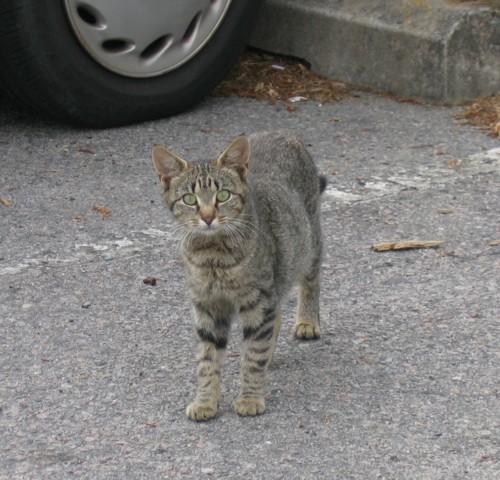
Early this spring a young tabby kitten showed up in the UNC "P" park and ride lot. Over the next couple of months, various commuters took to feeding her. We didn't know each other, only that the kitty's food bowl was kept filled. A couple of weeks ago, I put up a sign at the light post where we fed the kitty asking for contributions to get "him" neutered and vaccinated. According to everything I read about feral cats, trap, neuter and release (TNR) was the best we could do for him unless someone wanted to take him home. One woman responded to my post, and when we met, I learned that she, Kathy, had developed a very special rapport with the boy who she called Chay--Chapel Hill Gray.
POP-NC, Pet Overpopulation Patrol, comes to the Orange County Animal Shelter just up the road from the parking lot every Tuesday so I borrowed a Hav-A-Heart trap and set out to trap him. Unfortunately, we had major thunderstorms for the next 3 Mondays and in the interim we realized that he was getting pretty chubby. Over that week we finally realized that he was a she and she was probably pregnant. On Friday, I got an email from Kathy asking if I thought there might be two kittens. She said Chay had hissed and been very unfriendly the night before.
Over the weekend I agonized over how to handle her pregnancy. A veterinary friend assured me that it was best for Chay to go forward with the spay. She said feral cats who are forced to raise kittens in captivity are miserable and frequently end up killing their kittens. And allowing her to give birth in the parking lot was sure to bring just as much heartache since Chay had already been hurt once herself. I didn't see her on Friday or Saturday. But when I got to the lot of Sunday she came running for food and looked very thin. Were there two kittens--one pregnant and one not? Or had she given birth already?
According to the Feral Cat Coalition, if she had kittens we could still trap her and get her spayed but we would need to get her back to the site within 24 hours. So I made the appointment for this past Tuesday, and Kathy and I agreed to not feed her on Monday afternoon to increase the likelihood of a successful trap on Tuesday morning.
 I got to the lot early on Tuesday morning and set the trap before Chay's normal breakfast hour. Skinny Chay cooperated by showing up almost immediately, and walking right into the trap to get the food. And then she walked out--too light to have set off the trap. Notice how she is licking her lips!
Fortunately, I only put down a couple of bites since she was heading into surgery if the trap was successful. So I pushed so more of the nice smelly food onto the paper plate and got a long stick so that I could trip the lock myself. Success!
She fought like the proverbial wildcat, but I had followed the trapping advice from the Feral Cat Coalition and came prepared with an old sheet which I immediately draped it over the trap. She calmed right down and was a little lady throughout the car ride and the check in procedure.
Was it Chay that we trapped or were there two of them? I went back to the lot and put down more wet food to try and solve the mystery. To my great relief, the food was still there when I got back to the lot that afternoon. One feral kitty is enough!
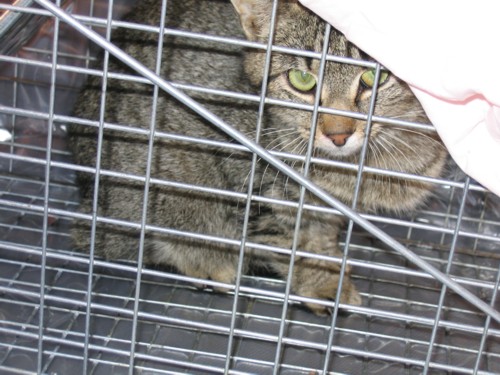 When I picked Chay up, I was told that she wasn't pregnant but she was lactating. From what I read and the POP folks confirmed, Chay needed to be kept indoors and warm for 24 hours after her surgery. The POP staff also felt like there was no point in returning her to the parking lot for the kittens because her milk had just about dried up, indicating that the kittens, if there were any, were old enough to eat on their own.
Kathy had decided to take Chay home after the surgery so I picked her up and met Kathy for the handoff. Unfortunately, Chay started waking up just as we were transferring her to Kathy's car for the ride to Durham. She was totally freaked out, swaying from side to side and banging her head into the sides of the cage. It was absolutely heartbreaking. But once again, once we covered the cage, she calmed down. What we had hoped would be a perfect ending for our beautiful little girl was marred by our fear for the kittens. We put up another sign and agreed to do what we could to find them, if there were any.
Since Chay had gone from chubby to skinny over about 4 days the week before, I felt like she had miscarried or the kittens had died prematurely, but Kathy wasn't willing to take that chance. She returned Chay to the parking lot the next day. I've been out everyday since, but Chay isn't going to have anything to do with me. And there are no sign of any kittens still.
As much as I wanted Chay to live happily ever after with Kathy, I love knowing she's somewhere around the parking lot. Parking lots are such barren wastelands and her presence adds a humanizing factor that I didn't know I was missing before she came to live there. I'm still hoping we can recapture her and convince her that living with Kathy is a better life than living on asphalt, but in the meantime, I look forward to going to work everyday and seeing our P lot kitty.
Subscribe to:
Posts (Atom)